
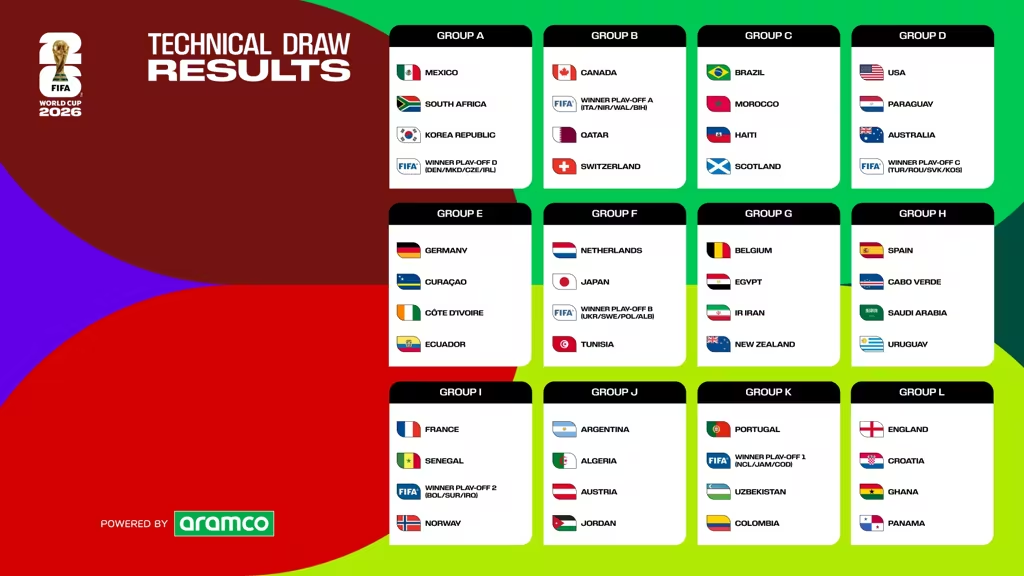
The FIFA World Cup 2026 marks the most significant structural change to the tournament format in more than four decades. For the first time, 48 national teams will compete rather than the 32-team field that defined the tournament from 1998 through 2022. Understanding how the new format works is essential both for following the competition and for planning your match attendance in Dallas-Fort Worth.
From 32 to 48: Why FIFA Changed the Format
FIFA announced the expanded 48-team format in January 2017, with President Gianni Infantino citing increased global participation, new commercial opportunities, and the opportunity to bring the world's most popular sporting event to more countries and regions as the primary drivers.
"The World Cup will be even bigger, even better," said FIFA President Gianni Infantino at the announcement. "More nations will have the opportunity to participate and compete at the highest level of the game."
The expansion was not without controversy. Critics — including numerous coaches, players, and soccer analysts — argued that a larger field would dilute competitive quality, extend the tournament to an unwieldy length, and potentially result in more lopsided group matches. Proponents countered that the format change would accelerate soccer development across Africa, Asia, and the Americas by giving more nations tournament experience at the senior level.
Whatever the merits of the debate, the 48-team format is now confirmed for 2026, and fans attending matches at AT&T Stadium need to understand how it works.
The 12-Group Structure
The 48 qualifying teams are divided into 12 groups of 4 teams each, labeled Groups A through L. Each team plays three group stage matches — one against each of the other teams in its group. Points are awarded on the standard FIFA system: 3 points for a win, 1 point for a draw, 0 points for a loss.
Group Stage Tiebreakers (in order): 1. Total points 2. Goal difference (goals scored minus goals conceded across all group matches) 3. Total goals scored 4. Head-to-head points (between tied teams only) 5. Head-to-head goal difference 6. Head-to-head goals scored 7. Fair play points (based on yellow and red card accumulations) 8. FIFA ranking at the time of the draw
Understanding these tiebreakers becomes crucial in close group tables. At the 2022 World Cup, several groups were not resolved until the final minutes of the final round of matches, with goal difference ultimately deciding qualification. In a 48-team format, these scenarios are even more common given the larger number of closely competitive groups.
Who Advances From the Group Stage?
This is the key change from the 32-team format. Under the previous system, the top 2 teams from each of 8 groups advanced to a Round of 16. Under the new 48-team format:
The top 2 teams from each of the 12 groups advance automatically — that's 24 qualified teams.
Additionally, the 8 best third-place finishers across all 12 groups also advance, bringing the Round of 32 field to 32 teams in total.
The "best third-place" calculation uses the same tiebreaker criteria listed above. If four teams in Group C all finish on 3 points, the third-place qualifier from that group might have identical raw statistics to a third-place team in Group G that also finished on 3 points — in which case head-to-head records, goal difference, and eventually drawing of lots determine which third-place finisher claims a Round of 32 berth.
This mechanism means that teams can be eliminated on the final day of group play even while holding a positive points total. Following multiple groups simultaneously on the final match day is part of the drama that makes the World Cup unique.
The Knockout Stage After Group Play
Once the 32 Round of 32 qualifiers are determined, the tournament proceeds as single-elimination:
Round of 32 → Round of 16 → Quarter-finals → Semi-finals → Final
This five-round knockout structure is two rounds longer than the 1998-2022 format. The extended bracket means that a team winning the 2026 World Cup will have played a minimum of 8 matches (3 group stage + 5 knockout rounds), compared to 7 matches required under the old format.
For Dallas-Fort Worth fans, the practical implication is significant: AT&T Stadium hosts matches from the Round of 32 through the Semi-final. A team could theoretically play at AT&T Stadium in a group stage match, return for a Round of 32 match if their bracket falls correctly, and then play again in the semi-final. Fans who secure tickets across the tournament could see the same national teams multiple times in Arlington.
Confederation Allocations and What to Expect
The 48 qualifying berths are distributed across the six FIFA confederations. Under the allocation confirmed for 2026:
- CONMEBOL (South America): 6 berths + 1 inter-confederation playoff spot - UEFA (Europe): 16 berths - CAF (Africa): 9 berths + 1 inter-confederation playoff - AFC (Asia): 8 berths + 1 inter-confederation playoff - CONCACAF (North & Central America, Caribbean): 6 berths (including the 3 host nations — USA, Canada, Mexico) - OFC (Oceania): 1 berth + 1 inter-confederation playoff
The UEFA allocation of 16 teams means that European soccer will be heavily represented in Dallas, which historically draws strong European fan contingents. The 9-team African allocation — up from 5 in the previous format — means that Brazilian, Ghanaian, Moroccan, Senegalese, and Cameroonian fan communities in the DFW area will have a higher probability of seeing their national teams compete at AT&T Stadium.
For context: the DFW Metroplex has substantial communities of people born in or with heritage from Mexico, Brazil, El Salvador, Honduras, Nigeria, Ethiopia, France, Germany, and the Netherlands — all nations with strong qualification histories. The fan energy in the stadium during a Mexico match at AT&T Stadium, in particular, will be extraordinary given that Dallas is home to one of the largest Mexican-American communities in the United States.
Following Standings in Real Time
During the 2026 tournament, official group standings will be updated in real time at FIFA.com and through the official FIFA+ app. The AT&T Stadium scoreboard and concourse screens will display live standings from other matches during group play, keeping the sold-out crowd informed about the broader implications of each goal scored around the tournament.
For fans who want to understand at a glance whether a 2-2 draw in Group F helps or hurts their team's Round of 32 prospects, the key things to track are: total points, goal difference, and goals scored — in that order.
Practical Implications for Match Tickets
The expanded format creates a slightly different ticket market than previous World Cups. Group stage tickets are somewhat more available and less expensive than knockout-round tickets, but they carry a risk: you may not know which teams are playing in your group stage match when you purchase tickets. Tickets are sold by "Match ID" and "Session," not by specific national teams, since group assignments are not finalized until the draw.
Knockout-round tickets carry team uncertainty even closer to the event — you don't know which teams will play a given Round of 32 or Quarter-final slot until the results of earlier rounds are known. This uncertainty is part of the tournament's character and creates a specific type of demand that experienced World Cup travelers have navigated since 1990.
Sources
1. FIFA, "FIFA World Cup 2026™ Format and Competition Regulations" (fifa.com), January 2024. 2. CONCACAF, "2026 FIFA World Cup Qualification — Final Berth Allocations by Confederation" (concacaf.com), updated 2023. 3. Associated Press, "FIFA Votes to Expand World Cup to 48 Teams for 2026" (AP Archive), January 10, 2017.